


The Massage Politics Sheet
No Hype — No
Cheerleading — No
Hidden Details
Bringing you hard facts & clear analysis since 2002
31 August 2010
AB 1822 Senate Aftermath — Developing Political Clout
From my perspective as a scientist, journalist, and individual member of the board of directors (BOD) of the California Massage Therapy Council (CAMTC), yesterday was painful. It was hard to watch Susan Manheimer's campaign of smears and misinformation against CAMTC, as chair of the California Police Chief's Association (CPCA), be successful in the California senate. Far too many massage therapists have long memories of being disrespected by local police officials and this was essentially a continuation and political confirmation of that disrespect.
This issue has never been about doing thorough background checks and vetting of applicants for certification. CAMTC already has a process that includes checks with DOJ, FBI, and local court records (for plea bargains) as well as soliciting input from local law agencies. Nor was it about having access to law enforcement experience. CAMTC started with Rick McElroy on the BOD, representing the League of California Cities. Mr McElroy has since become head of CAMTC's Professional Standards Division (PSD) where, with several others with law enforcement backgrounds, he oversees review of flagged applications (denial process) and disciplinary actions. Rick McElroy has contributed his background of 32 years with LAPD (25 in vice) along with a positive attitude toward CAMTC efforts.
Nor was AB 1822 about transparency. CAMTC operates under the Bagley-Keene Open Meeting Act, which includes 10-day public notice of meetings. Closed sessions within such meetings occur only as consistent with Bagley-Keene and only as deemed proper and necessary by legal counsel (who is always present at meetings).
AB 1822 was, instead, simply the turf-battle push back of a hostile group of police chiefs who did not like CAMTC's insistence that state-level regulation applied to all cities in California, an insistence supported by the State Senate Business & Professions Committee Office, by the opinion of legislative counsel, and most recently in SB 294 (Negrete McLeod). Failing the original intent of totally gutting CAMTC, AB 1822 settled for placing two law enforcement personnel on the CAMTC BOD, and making such placement a monopoly of two law enforcement trade associations. AB 1822 has, from the start, been about turf and push-back.
So, the tactical next step in the battle against AB 1822 and CPCA bad behavior moves on to urging (and educating) the Governor to veto the bill. There's more, however, that should be done. It falls under the category of developing political clout for the massage therapy profession. Here's some thoughts.
First, do not contribute to state-wide political party coffers. To do so gives away part of your ability to differentiate between those politicians who are supportive of the massage therapy profession and those who buy-in to the continuing disrespect.
Second, do explicitly thank and support those politicians who support us. Third, when those who contribute to disrespect of the profession call for contributions, let them know that you won't support them and why (Remember AB 1822?). And, quite clearly after the totally outrageous swift-boating of CAMTC by the CPCA, if police or sheriff's organizations call for donations tell them NO and tell them why.
Back to AB 1822. Senators Aanastad, Negrete McLeod, and Romero all spoke explicitly against AB 1822. Please let them know of your appreciation. Those who supported us by going against the political fuming of the CPCA and voting No against the bill were:
Aanestad, Ducheny, Dutton, Harman, Hollingsworth, Huff, Kehoe, Leno, Lowentha,l Negrete, McLeod, Romero, Steinberg, Strickland, Wyland
Thank them, contribute to them, work for them. Support is a two-way street.
Those who affirmed the disrespect, misrepresentations, and outright lies from the CPCA by voting for AB 1822 included
Alquist, Ashburn, Blakeslee, Calderon, Cedillo, Cogdill, Corbett, Correa, Denham, DeSaulnier, Emmerson, Florez, Hancock, Padilla, Pavley, Price, Runner, Simitian, Walters, Wolk, Wright, Yee
Senator Oropeza was not present (illness). Senators Liu and Wiggins abstained against considerable political pressure to vote for the bill.
In general, the response of the massage therapy profession and the professional organizations has not been coherent enough to create political clout. Nor have we, as a profession, spent to time to develop relationships with and support from politicians before we need their vote. We can change that…starting right now. Reasonable estimates of the number of at-least part-time providers of massage range between 30,000-65,000 based on organizational membership, school graduates, and retention rates. Mobilized, we can have a good-sized voice.
23 August 2010
Why Writing a 'Kill AB1822' Letter Now is Important
Use the Massage Today form to send a message to the California State Senators today — kill AB 1822. This will likely be voted on tomorrow.
For current background on AB 1822 and the effort to kill it see my recent blog post in ABMP's Massage Professionals venue. Recall also that the original language of AB 1822 was designed to totally gut the Californian Massage Therapy Council (CAMTC), created last legislative session by SB 731. One has to consider this to be the intent and desire of the California Police Chiefs Association (CPCA), which is AB 1822's sponsor.
After negotiations with AB 1822's author Sandre Swanson broke down earlier in August, the following language was placed in SB 294, a bill authored by Senate Business, Professions, & Economic Development Committee chair Gloria Negrete McLeod.
Section 4614 is added to the Business and Professions Code, to read:
4614. The Legislature finds and declares that due to important health, safety, and welfare concerns that affect the entire state, establishing a uniform standard of certification and regulation of massage practitioners and massage therapists upon which consumers may rely to identify individuals who have achieved specified levels of education, training, and skill is a matter of statewide concern and not a municipal affair, as that term is used in Section 5 of Article XI of the California Constitution. Therefore, this chapter shall apply to all cities and counties, including charter cities and charter counties.
This language, which came from legislative council, simply makes explicit council's existing opinion that SB 731, in creating a system of state-level certification that exempts CAMTC certificants from local licensing laws, applies to all cities, whether common law or charter. It is consistent with the already well-recognized precedent that occupational regulation is a matter of state rather than local concern — i.e. state law preempts local law. AB 294, with this language intact despite CPCA attempts to amend it, passed the senate 32-0. At least that day, the senators weren't buying the CPCA iine of shenanigans.
To see why it is important, with likely less than 24 hours remaining to send letters to state senators asking them to kill AB 1822, look at this letter from the California Police Chiefs Association (CPCA) to the state senators regarding the language above.
- They claim such language is a surprise, but the language was discussed during negotiations regarding AB 1822, with members of legislative counsel present.
- They are claiming that CAMTC is given exceptional pre-emptive powers. The truth is that state occupational regulation has normally preempted local law.
- They claim a background of CAMTC problems. Such problems don't exist. CAMTC has always worked with local law enforcement. In fact, CAMTC started with a representative, Rick McElroy, from the California League of Cities, who had 25+ years experience in LAPD's vice division. CAMTC currently has Mr. McElroy on staff, leading other staff with law enforcement experience in reviewing flagged applications. The actual motivation for AB 1822 was not problems with CAMTC but that a small number of police chiefs did not like state-level regulation of the massage therapy profession.
- They claim support from human trafficking organizations. To the best of my knowledge, such support doesn't exist. One major human trafficking did originally support AB 1822 several months back, but removed such support when contacted and informed of the bill's actual language and intent.
So what we see is a continuing pattern of CPCA fabrications. Do we really want representatives from such an organization on the CAMTC board? Would they improve leadership or public protection? Not hardly. Use the Massage Today form to send a message to the California State Senators today — kill AB 1822. This will likely be voted on tomorrow, so do it now.
Update: And here's even more reason in the latest letter produced by CPCA — the reason being mendacity.
Just for the record:
CAMTC already does background checks with DOJ and the FBI as well as court record checks.
CAMTC already has Public Policy & Local Government Committee meetings to listen and respond to local agency concerns.
CAMTC already has Professional Standards Division staff that have extensive law enforcement experience reviewing flagged applications.
If you are tired of CPCA lies, tired of CPCA fabrications, and feeling they shouldn't be rewarded by a place on the CAMTC board of directors, then write that letter.
21 May 2010
Where's Joe Friday When We Really Need Him?
In the long running radio and TV show Dragnet, Sgt Joe Friday often made statements like "All we want are the facts, ma'am" and "All we know are the facts, ma'am". This evolved into the iconic phrase "Just the facts, ma'am" in a parody of Dragnet by Stan Freberg called St. George and the Dragonet.
Unfortunately, at least some of the California Police Chiefs don't seem to hold with Sgt. Friday's fact-based orientation, seemingly being more inclined to writing their own fictional stories, at least according to an article published today by Massage Today. Is it suddenly NaPoCreFicMo (National Police Creative Fiction Month)? The article specifically mentions Police Chief Susan Manheimer of San Mateo, CA as one deserving an award for her skills with creation of fiction.
In an escalation of journalistic oversight, Massage Today has also sent Chief Manheimer a formal request for data under the California Public Records Act. While use of the Federal Freedom of Information Act has been frequently used by journalists, this likely marks a first for investigative journalism relative to the massage profession.
At this time, AB 1822 sits in the suspense file of the California Assembly's Appropriations Committee. Although it's a year old, this article by Greg Lucas of California's Capitol describes the function of the suspense file. For AB 1822, the motivating factor for suspense was concerns raised by the state's Department of Justice (DOJ) over increased costs of background checks by local agencies, should AB 1822 pass as currently written. At the same time, just prior to a committee hearing on 19 May, a "No on AB 1822" form put online by Massage Today was reported to have sent over 1300 letters to all seventeen Appropriations Committee members and to the bill's author Sandré Swanson. Although it was already expected that the bill would go to the suspense file (via a call from the committee's consultant about the DOJ concerns), it was interesting that Swanson didn't present the bill. This also meant that those opposed to the bill didn't present and that the committee members didn't ask questions "on the record" of Swanson and proponents.
While this may be an indication that input from the massage profession is starting to have an effect, we shouldn't get complacent. We can conclude that we have been heard when the bill is withdrawn or dead, not before.
Meanwhile, there's a huge disparity between AB 1822's effort to drag California massage therapy regulation back to the local level and long-terms efforts from the profession toward rational regulation as a health care profession. Such efforts are also embodied in the formation of the Federation of State Massage Therapy Boards (FSMTB) and coupled with efforts, such as the recent conference on Highlighting Massage Therapy in CIM Research, toward an evidence-informed practice of massage therapy. With over 40 states regulating massage therapy at the state level, it's little wonder that AB 1822 is anathema to the entire profession. The above are among the good reasons why it will benefit the entire massage profession to step up and use our combined weight of opinion to keep AB 1822 from passing. Do your part! Use the online form and provide your input.
My hope and belief is that there are still a lot of fact-based, conscientious, Joe and Jill Fridays out there. Now, if they could quietly suggest to their more fiction-oriented colleagues to clean up their acts…
17 April 2010
AB 1822 — How Cynical Can You Get?
Important! Action needed immediately! (see last paragraph)
As I've previously noted, SB 731, passed in the 2007-2008 California legislative session, provided a means of voluntarily moving regulation of the profession of massage therapy from the local to the state level. In short, it set up a nonprofit certification organization (CAMTC)under state review that included exemptions for those certified from local licensing laws. SB 731 also included a provision, for certified sole-proprietors and businesses using only CAMTC certified personnel to provide massage services, that zoning must be in accord with that for other personal and professional service businesses — i.e. no targeted zoning. While using a nonprofit organization to implement voluntary regulation at the state level is, to my knowledge, unique to California, the general move toward state rather than local regulation of the profession is not. Forty states have now implemented state regulation of the profession of massage therapy. This level of state regulation has facilitated the formation of the Federation of State Massage Therapy Boards (FSMTB), of which CAMTC is a member. In turn, FSMTB is a member of the Federation of Associations of Regulatory Boards (FARB).
Since 29 October 2009, I've had an insider's view of the workings of CAMTC, having been seated then on the board of directors (BOD). I was seated as the representative of the Independent Massage School Association of California (IMSAC) based on my journalistic activism and former work with the prior California Alliance of Massage Schools (CAMBS) (which dissolved in 2007). I'll note that my writings here are from my individual journalist perspective and are not statements of board policy.
What I've seen since October is basically an organization getting far more applications than were anticipated in advance and one practicing a high level of due diligence in screening applicants. On the first matter, about 3600 applications were anticipated in advance (i.e. in July 2009) for 2009 and over 14,000 were received. On the matter of screening, applicants are live-scanned with separate background reports received from the State Department of Justice (DOJ) and from the FBI. Unlike most local agencies, CAMTC also subscribes, at extra cost, to subsequent report notification. In addition CAMTC checks court records for possible instances in which prostitution arrests were plea-bargained to a lessor offense. Because California's private postsecondary school oversight agency was nonexistent from July 2007 until January 2010, CAMTC has also had to investigate, in some instances, whether or not an individual school's transcripts could be relied upon as prima facie evidence that, in all cases, the claimed education was actually received. Based on those investigations, it was determined for about 20 schools that transcripts could not be taken as sufficient proof (prima facie evidence) of education. Graduates from these schools are not necessarily denied certification, but are required to provide additional proof of education and knowledge.
Rick McElroy, the BOD representative of the League of California Cities, who provides a background of 30+ years experience working vice on the Los Angeles Police Department, has been both a valuable resource and a cordial CAMTC colleague. Rick, to our great gratitude, has also put in far more hours than he could ever have expected to help implement CAMTC review and education verification procedures. CAMTC has also worked with a number of local agencies to ensure that screening procedures are thorough and that certificants are legitimate members of the massage profession. The vast majority of local agencies are happy to see CAMTC take on the burden of background checks and education verification. For them, CAMTC is a collaborative partner. A few cities, however, have not at all liked losing local control of massage therapy licensing and have taken that dislike to the California legislature in the form of AB 1822, a bill that as initially worded would have abolished CAMTC.
Specifically, AB 1822 is the child of the executive committee of the California Police Chiefs' Association, headed by Susan Manheimer of San Mateo. In contrast to this small group, a more general local agency reaction is expressed by the reaction of the Association of California State Association of Counties (CSAC) to the bill.
AB 1822 would place new, and potentially burdensome, requirements upon local law enforcement by reassigning a portion of the massage therapy board’s previous responsibilities to the local law enforcement agencies where a massage therapy business is located. The measure would require a massage therapy business permit applicant to be investigated by the local law enforcement agency in whose jurisdiction the potential business would be located prior to the applicant being certified. Specifically, the law enforcement agency would be responsible for completing a background check, fingerprinting and approving the applicant’s fitness prior to the board certifying the business.
CSAC has serious concerns regarding this measure and the new workload it contemplates placing on local law enforcement agencies.
What's particularly cynical about the effort of the AB 1822 promoters is that they have tried to sell it, not simply as a local control issue and attempt to undermine appropriate state regulation of a profession, but as an anti-human trafficking bill. One need only compare the language of AB 1822, however, with the U.S. Attorney General's Report to Congress on U.S. anti-trafficking efforts or the the Model State Anti-Trafficking Statute to see that this bill is bears no commonalty of issues to true anti-trafficking concerns.
In it's attempt to cynically co-opt anti-trafficking to win support, AB 1822 deserves not only your opposition but your disdain. The bill comes before the Assembly Business and Professions Committee next Tuesday, 20 April. Please contact committee members immediately by email or phone to express your opinion.
18 July 2009
SB 731 — Could CAMTC Die from Success?
There's a possibility that SB 731 and CAMTC could become too successful and run themselves aground on legal shoals. The crux of the problem stems from whether or not courts would consider SB 731 to be a title act or a practice act. That consideration itself is not necessarily fixed but could depend on how the law is actually applied. Let me explain.
In deciding on a legal matter brought before them, courts look at both the wording of the law and at the application of the law. As long ago as 1886, in Yick Wo v. Hopkins (118 U.S. 356), the U.S. Supreme Courted noted that a law can in wording be fair but in application discriminatory.
Though the law itself be fair on its face and impartial in appearance, yet, if it is applied and administered by public authority with an evil eye and an unequal hand, so as practically to make unjust and illegal discriminations between persons in similar circumstances, material to their rights, the denial of equal justice is still within the prohibition of the Constitution.
It is not, per se, in the wording but in the potential applications that SB 731 could stand at risk. Let's step back to look at how we came to SB 731.
Back in January 2005, the massage prefession had a surnise hearing before California's Joint legislative Committee on on Boards, Commissions & Consumer Protection. The committe then reviewed the need for state massage regulation and determined that, while licensing (i.e. a practice act) was not warranted by high potential harms of practice, there was a need to provide a more uniform alternative to the vagaries, differences, and occasionaly onerus requirements of local licensing laws. Liz Figueroa was, at that time, chair of the Senate Business and Professions Committee and thus of the Joint Committee. Her office drew up SB 412 (2005-2006 session) modeled on a private organization created under state law for certification of interior decorators. SB 412 died in the last minutes of the 2006 legislative session, likely due to intense opposition lobbying by the California Chiropractice Association over a scope of practice that included passive movement and stretching. SB 731 essentially started its journey to passage in the 2007-2008 legislative period by taking the wording of SB 412 with any scope of practice wording removed. With Figueroa termed out of office, Jenny Oropeza took over bill authorship along with herself moving from the Assembly to the Senate.
The interior decorator bill on which SB 731 was modeled was simply a title protection bill — one that restricts the use of certain titles to those certified. SB 731, however, took a further step. It created an exemption from local licensing laws for those certified by CAMTC. It is this exemption that creates much of the benefit from SB 731 and that could also pose a legal hazard to the law itself.
CAMTC, although authorized by state law, is a private nonprofit. As such, it can administer a voluntary certification, but it cannot license massage. Only a state board or regulatory agency can license. As determined by the U.S. Supreme Court in California Liquor Dealers v. Midcal Aluminum, 445 U.S. 97 (1980), a state can use a private agency in regulation of commerce and be immune from anti-trust law only if it a) serves a clearly articulated and affirmatively expressed state policy, and b) the policy must be "actively supervised" by the State itself. For any mandatory regulation, there also exists issues of membership and costs of "expressive speech" that I've outlined in a white paper.
The danger for CAMTC occurs if, in application, SB 731, begins to look like a mandatory requirement. As long as the majority of cities and counties maintain their own, independent licensing laws this is not the case. If, however, a significant number of local agencies do away with their own licensing and simply require CAMTC certification, then SB 731 starts, in application, to look more and more like a licensing law. If that occurs, CAMTC might well find itself in legal muddles. It wants to be successful, but not too successful. The regulatory model on which CAMTC is based requires the delicate balance of encouraging individual practitioners to certify while encouraging cities to provide an alternative. Successful, but not mandatory. It remains to be seen if SB 731 and CAMTC can walk that line.
16 July 2009
SB 731 — CAMTC, the Written Law, and Rational Basis
In yesterday's post, I explored the wording of the eligibility requirements in §4601 of SB 731 and my belief that, by overstepping its role in implementing SB 731 as written, the CAMTC board is unnecessarily creating a potential for legal challenges to its actions. Specific to the issue of adding prerequisites to the provision for qualification by competency exam contained in §4601(c)(2), some might be tempted to ask about the role played by legislative intent. Did the legislature intend to provide a qualification path by demonstration of knowledge without requiring specific education?
As it turns out, legislative intent is not generally an issue considered by the courts. The courts instead look at the wording of the law, as passed, and whether or not there exits any rational basis for the law as it was worded on passage. This conclusion is well supported and summarized in the Writ of Certiorari of the U.S. Supreme Court in FCC vs Beach Communications (1993).
On rational basis review, a classification in a statute such as the Cable Act comes to us bearing a strong presumption of validity, see Lyng v. Automobile Workers, 485 U.S. 360, 370 (1988), and those attacking the rationality of the legislative classification have the burden "to negative every conceivable basis which might support it," Lehnhausen v. Lake Shore Auto Parts Co., 410 U.S. 356, 364 (1973) (internal quotation marks omitted). See also Hodel v. Indiana, 452 U.S. 314, 331-332 (1981). Moreover, because we never require a legislature to articulate its reasons for enacting a statute, it is entirely irrelevant for constitutional purposes whether the conceived reason for the challenged distinction actually motivated the legislature. United States Railroad Retirement Bd. v. Fritz, supra, at 179. See Flemming v. Nestor, 363 U.S. 603, 612 (1960). Thus, the absence of " `legislative facts' " explaining the distinction "[o]n the record," 294 U. S. App. D. C., at 389, 959 F. 2d, at 987, has no significance in rational basis analysis. See Nordlinger v. Hahn, 505 U. S. ___, ___ (1992) (slip op., at 13) (equal protection "does not demand for purposes of rational basis review that a legislature or governing decisionmaker actually articulate at any time the purpose or rationale supporting its classification"). In other words, a legislative choice is not subject to courtroom fact finding and may be based on rational speculation unsupported by evidence or empirical data. See Vance v. Bradley, supra, at 111. See also Minnesota v. Clover Leaf Creamery Co., 449 U.S. 456, 464 (1981). " `Only by faithful adherence to this guiding principle of judicial review of legislation is it possible to preserve to the legislative branch its rightful independence and its ability to function.' " Lehnhausen, supra, at 365 (quoting Carmichael v. Southern Coal & Coke Co., 301 U.S. 495, 510 (1937)).
It certainly can be determined that there is a rational basis for determining eligibility for certification by an explicit demonstration of knowledge. SB 731, as passed by both houses of the California legislature in 2008, contained just such a means of qualification in §4601(c)(2)(B). Given rational basis and the precedent above, it seems likely that the courts would hold that SB 731 should be implemented as it is written. Ignoring such precedent only creates unnecessary legal exposure for the CAMTC and the massage profession in California. There are means to change the law via the legislative process, but simply ignoring the way SB 731 was actually written and passed is not one of them.
15 July 2009
SB 731 — Is the CAMTC Board Overstepping?
Our decision was based on what we thought the law said. Not on what we thought would be right in the law. That question we leave to the Council to decide and if it changes it, so be it. That is their prerogative as legislators to change that if they disagree, but we wanted to make sure that the Council understands our decision was not based on what we think the law should be, but only what we thought the law said as it exists. — Sonia Sotomayor
As I write this, the Senate confirmation hearings for Judge Sonia Sotomayor are in their third day. One of the pivotal issues of questioning has been the extent to which Judge Sotomayor sticks with applying the wording of the law versus more “activist” interpretations. As a tertiary to this process, the New York Times looked back through the history of memos written by Judge Sotomayor. They note that:
“On Dec. 11, 1991, at a meeting of the New York City Campaign Finance Board, where she was a member from 1988 until she became a federal judge in 1992, Ms. Sotomayor objected to interpreting laws in a way that would alter the plain meaning of the text written by lawmakers — even if doing so would be an improvement on policy grounds.”
Unfortunately, the CAMTC board shows every indication of being less deferential to the law as written than the honorable Judge. The board seems to feel that they should rework SB 731 to achieve what they may have wished the law said rather than implementing it as it written. This is a matter of grave concern, for it potentially and unnecessarily opens up CAMTC to legal action. It is the duty of the State Attorney General's Office to defend California laws in court. However, a legal defense would more likely would fall on the CAMTC alone, even as a private organization created by state action, if the CAMTC oversteps the written law in its requirements. The board would be far wiser to follow Judge Sotomayor in implementing the law as written than in being adventurous. Much of this has to do with implementation of eligibility requirements. Let's look at the specifics of §4601(a through c) which stipulates eligibility requirements.
4601. (a) The organization shall issue a certificate under this chapter to an applicant who satisfies the requirements of this chapter.
(b) (1) In order to obtain certification as a massage practitioner, an applicant shall submit a written application and provide the organization with satisfactory evidence that he or she meets all of the following requirements:
(A) The applicant is 18 years of age or older.
(B) The applicant has successfully completed, at a single approved school, curricula in massage and related subjects totaling a minimum of 250 hours that incorporates appropriate school assessment of student knowledge and skills. Included in the hours shall be instruction addressing anatomy and physiology, contraindications, health and hygiene, and business and ethics, with at least 100 hours of the required minimum 250 hours devoted to these curriculum areas.
(C) All fees required by the organization have been paid.
(2) New certificates shall not be issued pursuant to this subdivision after December 31, 2015. Certificates issued pursuant to this section or subdivision (a) or (c) of Section 4604 on or before December 31, 2015, shall, after December 31, 2015, be renewed without any additional educational requirements, provided that the certificate holder continues to be qualified pursuant to this chapter.
The above sets out the requirements for certification at the practitioner level. This requires 250 hours of total training at a single approved school, including 100 hours specific to given areas of study. While the issuing of new certificates at this level ends with the sunsetting of SB 731 itself at the end of 2015, practitioner certificates issued before then can be renewed indefinitely, as long as they are never allowed to lapse.
Note, in particularly, that there is no change in the requirements over time for such certificates as long as they are being issued. In particular, there is no “ramping-up” of eligibility requirements while they are issued.
(c) In order to obtain certification as a massage therapist, an applicant shall submit a written application and provide the organization with satisfactory evidence that he or she meets all of the following requirements:
(1) The applicant is 18 years of age or older.
(2) The applicant satisfies at least one of the following requirements:
(A) He or she has successfully completed the curricula in massage and related subjects totaling a minimum of 500 hours. Of this 500 hours, a minimum of 250 hours shall be from approved schools. The remaining 250 hours required may be secured either from approved or registered schools, or from continuing education providers approved by, or registered with, the organization or the Department of Consumer Affairs. After December 31, 2015, applicants may only satisfy the curricula in massage and related subjects from approved schools.
(B) The applicant has passed a massage and bodywork competency assessment examination that meets generally recognized psychometric principles and standards, and that is approved by the board. The successful completion of this examination may have been accomplished before the date the organization is authorized by this chapter to begin issuing certificates.
(3) All fees required by the organization have been paid.
As with the previous section, this section sets minimum requirements for the applicant; this time for certification at the therapist level. Note the the distinction is in hours and titles only. The therapist is not guaranteed to have any additional specific outcomes of training nor do they have any additional rights or privileges. It is a marketing distinction only.
Paragraph (2) stipulates that the applicant demonstrate that they have either completed 500 hours of training (with 250 hours at an approved school), OR that they have passed an approved competency exam. An exam should be construed as just that; not a work history requirement, not an external certification process. The law is as it is. The phrase at least is specific to what the applicant must provide, not to the authorities of the board.
Now let's see where the CAMTC board is going, in their board minutes of 18 June 2009. First, let's consider the exam option under 4601(c)(2) above. For the two exams provided by the NCBTMB, board has voted to disallow use of the NESL option on the application. In other words, rather than requiring an exam, they are requiring completion of a NCBTMB certification process. The following description of what the NESL option implies was taken from the NCBTMB candidate application form:
If a candidate does not wish to become nationally certified, but is still required to take and pass the National Certification Examinations in order to practice in a particular jurisdiction, then he or she may select, NCBTMB National Examination for States Licensing (NESL) option.The NESL option is available to any candidate who is denied eligibility for certification through NCBTMB, either by the traditional application or portfolio review process. In addition, the NESL option is available to candidates who do not wish to become nationally certified or do not meet the eligibility criteria that are outlined in this the National Certification Examination Candidate Handbook. Candidates who select the NESL option are not required to submit notarized copies of diplomas and/or official transcripts. However, candidates are still required to adhere to all policies and procedures associated with the examinations, as they are outlined in the National Certification Examination Candidate Handbook."
The exams are the exactly the same under the NESL option as without it. The difference is that the NESL option enables taking the exam without becoming certified. What the CAMTC is working to require, for the NCBTMB exams, is NCBTMB certification. What SB 731 requires is the exam, not the certification. At this time, the NCBTMB is moving to become a explicit member organization with members composed of certificants. Requiring membership in a private organization and requiring use of funds for “expressive speech” are legally problematic; something I've discussed in a separate white paper.
My understanding also, from multiple persons, it that with the Federation of State Massage Board's (FSMTB) MBLEx, the CAMTC is planning to allow the exam, but only with other proof of two years of work experience. Again, the CAMTC board is stepping beyond what the law quite specifically requires. Moreover, looking at item #11 in the 18 June board minutes, the board proposed to only accept the exam option until January 2012 and then require 500 hours from everyone for the therapist designation. Once again, the law language contains no such time schedule. This is entirely an agenda of those running the CAMTC in contradiction to the wording of the law.
One might reasonably ask how the board has convinced itself that it has these powers of rewriting the law. The key seems to be in item #8 in the 18 June minutes.
Steve Lindsey (AMTA Lobbyist) mentioned that the key words are “at least”, with regards to the question of Either/Or. The act gives the board the authority of at least – meaning that this would be the minimum.
This is a reference to the at least in the line starting §4601(c)(2). But this section is specifically referring to what the applicant must demonstrate, not to the liberties of the CAMTC role. If Mr. Lindsey's interpretation were true, the the phrases “minimum of 250 hours” and “minimum of 500 hours” in §4601(b) and §4601(c) would also be a stipulation of the minimum hours that the CAMTC must require allowing them arbitrary designation beyond that. I suspect that a court would consider Mr Lindsey's interpretation to be a perverse one and disallow it. The more likely interpretation is not that the board has freedom, but that this section specifically and explicitly sets the minimum requirements that the applicant must meet. The CAMTC board is exhibiting adventurism at its worst.
It is the purpose and prerogative of the legislature to write the law and, when and if they chose, to rewrite it. One purpose of having regulatory bills sunset, as SB 731 does at the end of 2015, is to ensure periodic legislative reviews of the need and effectiveness of regulatory law. During the current enactment period, It is the purpose of the CAMTC to implement SB 731 as written. If they overstep, it could easily become the role of the courts to remind them of their purpose and limitations. As a profession, however, we shouldn't need to incur the waste of time and fees of unnecessary legal defense. The CAMTC should stick to the wording of the law. Where there is doubt, they would be well-advised to seek an opinion from the Office of the State Attorney General.
The bottom line is that SB 731 stands to go far in reducing the vagaries of being able to practice in California. At the same time, before I can recommend that massage professionals send in their money and applications, I believe that the CAMTC needs to demonstrate far greater respect for the letter of the law as opposed to their own wishes as to how that law should read. As Judge Sotomayor said during her hearings on 13 July,
It is simple: fidelity to the law
02 May 2009
SB 731 — Who are the CAMTC Board Members?
Unlike a state agency, the Board of Directors (BOD) of the private, nonprofit, California Massage Therapy Council (CAMTC) is not appointed by the legislature and/or governor. Instead, SB 731 stipulates that the board is composed of representatives of various types of agencies and associations that are stakeholders in massage regulation in California. Included are massage professional organizations (AMTA, ABMP), school associations (CCCO, CAMSA, CAPP, CCA), the League of California Cities (LCC), the California State Association of Counties (CSAC), and the California Department of Consumer Affairs (DCA). The notable group not included is a representative of the consumers of massage services, i.e. a public member.
Of the school associations, CAMSA is specific to California massage schools, CCCO represents the interests of California community colleges, and CAPPS and CCA are organizations of private postsecondary and vocational schools — career colleges for the most part. All can be considered to have a vested interest, but their interests are not necessarily the same and can, in fact, be conflicting.
An additional factor in the mix of school considerations is that the legislature set educational tier requirements at 250 hours and 500 hours, an implicit assumption that board actions will be supportive of the continued provision of training at those levels (or, as I note below, law suits could result). As noted in a prior post in this thread, such considerations become important because, while SB 731 doesn't authorize the CAMTC to approve schools, it does stipulate, in a vague and likely problematic manner, some verification of school adequacy.
4601(g) (1) The organization shall have the responsibility to determine that the school or schools from which an applicant has obtained the education required by this chapter meet the requirements of this chapter.
The implementation of this stipulation, given that California isn't currently regulating private, postsecondary schools, is bound to be a source of disagreement, argument, and, potentially, legal challenge if it strays from “legislative intent”.
With all of the above as a tee-up, here's the BOD list with links to each person's organizational affiliation.
- Bob Benson (vice-chair), ABMP
- Dr. Beth Chape, CCCO
- Ben Drillings, CAMSA
- Bev May, AMTA
- Richard C. McElroy, LCC
- Mason Myers, CAPPS
- Ahmos Netanel (chair), AMTA
- Supervisor Janet Nguyen, CSAC
- Dr. David Rabago, DCA
- Roberta Rolnick, ABMP
- Dr. Paul Schwinghamer, CCA
30 April 2009
SB 731 — What's My Line?
Today's breakdown on parts of California's SB 731 is going to be relatively short. I'm focusing on two short sections that lay out the status that being certified under SB 731 gives you and also what it doesn't allow title-wise.
First, however, a short reminder. At the state level, SB 731 certification is entirely voluntary. If you choose not to certify, you can continue to practice under local regulation of massage or lack of local regulation, however that might be. At the same time, there are no constraints on local agencies against changing their local laws in light of SB 731 for those who don't certify. It's entirely possible that some cities may effectively prohibit practice by those not certified. On the other hand, those practicing in the outbacks of far northern California might find little or no benefit of certification and choose not to go there. Now onto today's theme of what certification confers. Here's the bill language:
4605. It is an unfair business practice for any person to state or advertise or put out any sign or card or other device, or to represent to the public through any print or electronic media, that he or she is certified, registered, or licensed by a governmental agency as a massage therapist or massage practitioner.
4606. It is an unfair business practice for any person to hold oneself out or use the title of "certified massage therapist" or "certified massage practitioner" or any other term, such as "licensed," "registered," or "CMT," that implies or suggests that the person is certified as a massage therapist or practitioner without meeting the requirements of Section 4601 or 4604.
So first, SB 731 certification is handled by a state-authorized but still private organization, the California Massage Therapy Council (CAMTC). Those certified are certified by the CAMTC, not by any agency of the state. Moreover, it is a certification that exempts you from local licensing, not a license. So you can't claim to be state-certified, state-licensed, or state-registered. You aren't.
In §4606, the state preempts generic usage of the terms certified, licensed, and registered. You can't call yourself “licensed” because you are locally licensed by a city or county. You also can't call yourself state-licensed, because you aren't. Unless you are certified by the CAMTC, you also can't call yourself a “certified massage therapist” or CMT. If you have such terms on your business cards and don't plan on becoming certified under SB 731, plan on reprinting your business cards. These restrictions don't apply to specific, trade-marked certifications such as NCTMB, only to use of generic terms.
Interestingly, the language in SB 731 does not provide specific titles of usage for it's two tiers. It defines the practitioner level (250) hours and therapist level (500) hours for purposes of the bill itself. “4600. As used in this chapter, the following terms shall have the following meanings:…”. The language continues to define massage therapist and massage practitioner plus additional generic terms to apply to those certified under specific sections of the bill. There is no definition of specific titles to use externally in the bill itself, although these may be defined by CAMTC in the near future.
29 April 2009
What does SB 731 Buy You?
Today, I want to start a more detailed run-through of the provisions of SB 731. First, however, I want to side-track a little and talk about the California Massage Therapy Council (CAMTC) itself. Then we go on into specifics. The CAMTC is a private, California corporation created under the authorization of SB 731. As stipulated in that bill, the CAMTC has filed for nonprofit, 501(c)(3) status with the state Franchise Tax Board and the federal IRS. Under SB 731, the CAMTC gains certain certification privileges by state law that preempt local law. SB 731 explicitly makes the meetings and actions of the CAMTC subject to the provisions of the Bagley-Keene open meeting laws. The CAMTC also is under review by the state legislature. It's authorization expires on 1 January 2016, if not renewed. A renewal bill could include changes determined to be warranted or needed by the legislature.
In short, while the CAMTC is a private organization, it is accountable to the state and must follow the public openness requirements of a public agency. As a private agency, however, the CAMTC is not subject to state hiring freezes or furloughs nor is its budget part of the state's budget. Thus the CAMTC is not directly affected by California's often rancorous and often dysfunctional budget process. This is a distinct contrast to state licensing boards which can, despite being funded by fees, be subject to both hiring restrictions and fund raids (Word document).
Now, let's look at some specific language in SB 731.
4608. Nothing in this chapter is intended to limit or prohibit a person who obtains a certification pursuant to this chapter from providing services pursuant to, and in compliance with, Sections 2053.5 and 2053.6.
The sections referred to were enacted by SB 577 (2001-2002, Burton). Subject to restrictions on inherently invasive or dangerous acts, and subject to certain client notification requirements, 2053.5 and 2053.6 create an exemption from the medical practices act that allow claims of treatment by unlicensed practitioners. Those certified by the CAMTC still fall in the unlicensed category and SB 731 does not affect the rights of treatment created by SB 577. SB 731 also, by the way, does not stipulate any particular scope of practice or independly create a right to claim treatment.
4612. (a)
(1) The holder of a certificate issued pursuant to this chapter shall have the right to practice massage, consistent with this chapter and the qualifications established by his or her certification, in any city, county, or city and county in this state and shall not be required to obtain any other license, permit, or other authorization, except as provided in this section, to engage in that practice.
(2) Notwithstanding any other provision of law, a city, county, or city and county shall not enact an ordinance that requires a license, permit, or other authorization to practice massage by an individual who is certified pursuant to this chapter and who is practicing consistent with the qualifications established by his or her certification. No provision of any ordinance enacted by a city, county, or city and county that is in effect before the effective date of this chapter, and that requires a license, permit, or other authorization to practice massage, may be enforced against an individual who is certified pursuant to this chapter.
Quite simply, the above says that, if you are certified by the CAMTC, a city or county cannot require you to become locally licensed as a massage professional. You are thus free to practice anywhere within the state of California. If you are not certified by CAMTC, local licensing laws still apply. You are not required by the state to become certified, but if you are not, local agencies are free to license (or not license) you as they choose. Whatever definition of massage practice a local agency uses, certification exempts you from it.
The bill now moves to a rather lengthy section on the zoning of massage therapy establishments. While it leaves local agencies free to zone as they wish in general, it restricts them, for businesses that are run by certified sole-proprieters or that only use certified massage personnel, from negatively targeting massage therapy establishments.
(3) Except as provided in subdivision (b), nothing in this section shall be interpreted to prevent a city, county, or city and county from adopting or enforcing any local ordinance governing zoning, business licensing, and reasonable health and safety requirements for massage establishments or businesses. Subdivision (b) shall not apply to any massage establishment or business that employs or uses persons to provide massage services who are not certified pursuant to this chapter.
(b) (1) This subdivision shall apply only to massage establishments or businesses that are sole proprietorships, where the sole proprietor is certified pursuant to this chapter, and to massage establishments or businesses that employ or use only persons certified pursuant to this chapter to provide massage services. For purposes of this subdivision, a sole proprietorship is a business where the owner is the only person employed by that business to provide massage services.
(2) (A) Any massage establishment or business described in paragraph (1) shall maintain on its premises evidence for review by local authorities that demonstrates that all persons providing massage services are certified. (B) Nothing in this section shall preclude a city, county, or city and county from including in a local ordinance a provision that requires a business described in paragraph (1) to file copies or provide other evidence of the certificates held by the persons who are providing massage services at the business.
So you only get the benefits of the following section if you are certified and running a one-person business or have a larger business that only uses certified employees or certified independent contractors to massage clients. Furthermore, to gain this benefit, you have to maintain copies of certification on the premises and can additionally be required to file them with local agencies as part of the business license application.
(3) A city, county, or city and county may charge a massage business or establishment a business licensing fee sufficient to cover the costs of the business licensing activities established by a local ordinance described in this section.
Local agencies can charge you a reasonable fee to cover the costs of the described business licensing activities, but they cannot assess unreasonable or punitive fees or add in costs of additional activities.
(4) Nothing in this section shall prohibit a city, county, or city and county from adopting land use and zoning requirements applicable to massage establishments or businesses, provided that these requirements shall be no different than the requirements that are uniformly applied to other professional or personal services businesses.
From the massage business owner's perspective, this is the key and core provision of this entire section. Local agencies can still zone however they wish, however, they cannot target out massage businesses. They have to zone massage businesses, subject to the “entirely certified” restrictions above, just as they zone any other personal or professional services business.
(5) Local building code or physical facility requirements applicable to massage establishments or businesses shall not require additional restroom, shower, or other facilities that are not uniformly applicable to other professional or personal service businesses, nor shall building or facility requirements be adopted that (A) require unlocked doors when there is no staff available to assure security for clients and massage staff who are behind closed doors, or (B) require windows that provide a view into massage rooms that interfere with the privacy of clients of the massage business.
Nor can local agencies add in special facilities requirements or unsafe or invasive access requirements.
(6) A city, county, or city and county may adopt reasonable health and safety requirements with respect to massage establishments or businesses, including, but not limited to, requirements for cleanliness of massage rooms, towels and linens, and reasonable attire and personal hygiene requirements for persons providing massage services, provided that nothing in this paragraph shall be interpreted to authorize adoption of local ordinances that impose additional qualifications, such as medical examinations, background checks, or other criteria, upon any person certified pursuant to this chapter.
As with other personal contact businesses, reasonable health and safety provisions can be applied.
(7) Nothing in this section shall preclude a city, county, or city and county from doing any of the following:
(A) Requiring an applicant for a business license to operate a massage business or establishment to fill out an application that requests the applicant to provide relevant information.
(B) Making reasonable investigations into the information so provided.
(C) Denying or restricting a business license if the applicant has provided materially false information.
You still have to truthfully provide information to local agencies and the information you supply can be investigated. Providing false input is grounds for refusing you a business license.
(c) An owner or operator of a massage business or establishment subject to subdivision (b) shall be responsible for the conduct of all employees or independent contractors working on the premises of the business. Nothing in this section shall preclude a local ordinance from authorizing suspension, revocation, or other restriction of a license or permit issued to a massage establishment or business if violations of this chapter, or of the local ordinance, occur on the business premises.
(d) Nothing in this section shall preclude a city, county, or city and county from adopting a local ordinance that is applicable to massage businesses or establishments described in paragraph (1) of subdivision (b) and that does either of the following: (1) Provides that duly authorized officials of the city, county, or city and county have the right to conduct reasonable inspections, during regular business hours, to ensure compliance with this chapter, the local ordinance, or other applicable fire and health and safety requirements. (2) Requires an owner or operator to notify the city, county, or city and county of any intention to rename, change management, or convey the business to another person.
As the business owner, you are responsible for what occurs in the business. You are also subject to reasonable inspections.
Finally, the above is state law which preempts any conflicting local law. The CAMTC becomes the first-line resource on violations of the law, whether by practitioners or by local agencies. Thus, if a local agency is not in compliance with SB 731, the CAMTC should be notified along with the local agency attorney's office. Ultimately, it falls on the office of the state attorney general to defend the provisions of state law in court, should the law be legally challenged. If a local agency is recalcitrant, you are not in this by yourself.
28 April 2009
The California Massage Therapy Council
The private 501(c)(3) massage therapy certification organization authorized by enactment of last year's SB 731 is now titled the California Massage Therapy Council (CAMTC). Minutes from the Board of Directors meetings on 19 February and 4 March are now online at the CAMTC website. Minutes from the 17 March and 14 April Credentials Committee meetings are also online as of today.
The Credentialing Committee only has authority to make recommendations to the BOD. The limited authority of CAMTC toward massage schools was clarified in the 4 March minutes of the BOD.
It was noted the Board had authority to verify schools were “approved or registered” as defined in the statute and met the curriculum standards but did not have the right to “approve” schools.
Verifying that a massage school is legitimate is one of the thornier problems at this point, since the law authorizing state regulation of postsecondary schools expired in 2007 and was repealed in 2008. Status of postsecondary regulation is still reported on the former BPPVE website. The current bill potentially reinstating postsecondary school regulation is AB 48. In any case, no school regulation will be currently effective when the CAMTC begins issuing certificates.
Here in central California, the McKinnon Institute will hold an informational session on SB 731 on 4 May. It's anticipated that CAMTC will begin accepting applications for the 250 hour and 500 hour tiers authorized by SB 731 in August. The 500 hour tier can also be obtained by passage of an “approved examination” without meeting other educational prerequisites. More on that as it becomes formalized.
11 October 2008
NC Board votes to make MBLEx its primary exam
Last night, I received the following update from North Carolina, written by Rick Rosen, which delineates the NC Massage Board's decision to accept only the MBLEx after the end of 2010. Rick was the founding chairman and a past member of the North Carolina Board of Massage & Bodywork Therapy, and was the first Executive Director of the Federation of State Massage Therapy Boards.
The move to the MBLEx can essentially be considered as a natural evolutionary step of the profession. It took regulation of massage by a majority of states to motivate formation of an association of the individual boards and regulating agencies. Once that association formed, it was also expectable that provision of a licensing exam would be brought back under public control and accountability. Occupational licensing, and hence the control of prerequisites to licensing, is inherently the power and responsibility of the states under the U.S. constitution.
At yesterday's meeting of the North Carolina Board of Massage and Bodywork Therapy, the Board voted to make the Massage and Bodywork Licensing Examination (MBLEx) the only major test that will be accepted for "regular" licensure after January 1, 2011. During this 27-month transition period, the Board will continue to accept the two certification exams from NCBTMB. After the sunset date, the Board will only accept the NCETMB and NCETM for those candidates applying for Licensure by Endorsement who have relocated to North Carolina from a state that does not yet issue licenses. This is anticipated to be a limited scope of utilization.
The Board chose not to modify its existing approval of the Asian Bodywork Therapy Examination at the present time, which means it remains on the list of approved exams without restriction. (However, there are currently only two licensees who used the ABTE to become licensed in NC.)
The original motion that was introduced at this Board meeting had a 12-month phase-out period for the national certification exams. Following considerable discussion among Board members, the motion was amended to 15 months, then 24 months, then finally 27 months (minus nine days) — so that the sunset date would coincide with the start of a new year. While there was concern expressed about the relatively brief track record of FSMTB as an exam provider, the organizational structure that supports the MBLEx was determined to be in the best interests of the regulatory program, and therefore in highest support of public protection. The extended phase-out period was chosen to give all stakeholders adequate time to make the transition from the national certification exams to the MBLEx.
How did the Board get to this point of decision making? At its previous meeting on August 21, 2008, the Board voted to add the MBLEx to the list of examinations recognized for licensure (as set forth in Guideline 1.8). This action was contingent upon a forthcoming change to Rule .0201 that revised the criteria for Board approval of licensing exams. When that amended rule became effective on October 1, 2008, the MBLEx joined NCB's two national certification exams on the approved exam list, along with the Asian Bodywork Therapy Examination, given by NCCAOM.
It should be noted that Rule .0201 was changed to conform with the newly-amended examination requirements in the NC Massage and Bodywork Therapy Practice Act. This was part of a bill that was signed into law by Governor Mike Easley on August 18, 2008. Here is the change to G.S. § 90-629(5):
(Previous language) [the applicant] Has successfully passed an examination administered by a certifying agency that has been approved by the National Commission of Certifying Agencies (NCCA) and is in good standing with such agency or has successfully passed an examination administered or approved by the Board.
(New language) [the applicant] Has passed a competency assessment examination that meets generally accepted psychometric principles and standards and is approved by the Board.
The changes to both the statute and the rule remove the restrictive and exclusionary NCCA standard, which applies only to certification exams. In addition, the new language no longer requires that a candidate for licensure be certified by NCBTMB at the time of application. In its place is a broader and more inclusive provision that relies upon the prevailing standards in the psychometrics industry as a whole. The phrase "generally accepted psychometric principles and standards" is fully defined in a new definition contained in Rule .0102. This is language that can be considered as a model for other practice acts across the country. In fact, the two most recently enacted massage laws — California and Pennsylvania — contain this key referential phrase.
Earlier this year, the Board received in-person presentations from the leadership of both NCBTMB and FSMTB on their respective examination programs. Before making a decision on exam selection, this information was reviewed in detail, along with input the board had requested from massage school directors. Taken as a whole, these actions of the NC Board are consistent with the fundamental shifts that have occurred in the massage therapy field over the past several years, and affirm the role of the Federation of State Massage Therapy Boards as the preferred provider of licensing examinations for its Member Boards.
Additional resources:
The final text of Senate Bill 1314, which contained the amendments to the NC Massage and Bodywork Therapy Practice Act, may be downloaded from the website of the NC General Assembly.
The latest version of the NC Practice Act may be accessed from the Board's website.
Copies of the amended rules .0102 and .0201 may be obtained from the Board Office by contacting Bonnie Kennedy, Board Administrator.
01 October 2008
Another Year without a Postsecondary School Bureau
On Tuesday, September 30, 2008, Governor Schwarzenegger vetoed Senate Bill 823 which would have reestablished a bureau, under the Department of Consumer Affairs, to oversee operation of private postsecondary and vocational schools.More information is available from the DCA at the website of the former Bureau of Private Postsecondary and Vocational Education (BPPVE), which sunsetted in July 2007 after Governor Schwarzenegger vetoed an extension bill.
SB 823 had also drawn opposition from the California Association of Private Postsecondary Schools (CAPPS) and, according to CAPPS, was also opposed by the Department of Consumer affairs. The bill was 125 pages long, underscoring the complexity of requirements implicit in Schwarzenegger's veto message.
I have repeatedly stated that a reform act must be written clearly, should not be subject to varied interpretations, should treat schools as uniformly as possible, and provide reasonable roles and responsibilities for the Bureau. Our collective objective should be to successfully strike a balance between protecting students, while being firm, yet fair to schools. Unfortunately, this bill does not meet those goals. Instead, this bill would create a statute that would be a challenge to successfully implement. If a statute is not clearly drafted, reasonably enforceable, or easily understandable to students, schools, and regulators, no one is well served.
A Sacramento Bee editorial on 22 June had pointed out some of the problems with the bill. Inflexible bills can be a particular problem for areas of training such as massage and performing arts that often don't result in traditional job placement statistics. One of the sticky points of the current bill was in the Student Tuition Recovery Fund (STRF), essentially a fee levied against each enrolling student as a form of pooled insurance against school closures. Not only was there an explicit assessment, but a provision for special assessments should the pool run low. A string of school failures in one area of training could thus have potentially serious impacts on regulated schools across the board in the form of an unplannable expense.
30 September 2008
SB 731 Enacted in California
SB 731 was signed by Governor Schwarzenegger on 27 September, changing the regulation of massage from being local to being a mixture of state and local regulation. SB 731 authorizes creation of a 501(c)(3) non-profit organization to certify massage therapists at the state level. The "organization" remains under legislative review and is subject to the due process and open meeting laws (Bagley-Keene) typical of public agencies. Through 2015, it provides for two-tiers of certification: "massage practitioners" at 250 hours of training and "massage therapists" at 500 hours of training. After 2015, no new 250 hours certificates would be issued, however, previously issued certificates would continue to be renewable. The bill itself, however, sunsets (expires) at the end of 2015, unless renewed, so the expiration of the "massage practitioner" level would only have impact after renewal of the bill and only if the renewal didn't change the language stipulating such expiration.
In the meantime, there is no practical difference between the two tiers. The 250 hour tier stipulates that "Included in the hours shall be instruction addressing anatomy and physiology, contraindications, health and hygiene, and business and ethics, with at least 100 hours of the required minimum 250 hours devoted to these curriculum areas." The 500 hour tier does not add any specific training or outcomes of training. It is thus more of a marketing distinction than any additional stipulation of well-defined training outcomes. Particularly if one is going to eliminate the 250 hour tier, the public should be guaranteed that the 500 hour tier represents a well-defined curriculum teaching a clearly defined body of knowledge and skills with well-specified training outcomes. This lack should be addressed before the legislative renewal of the bill.
There is an interesting feature to the "500 hour tier" in that it requires [4601(c)(2)] satisfying one of either the 500 hour curriculum requirement or passage of a "massage and bodywork competency assessment examination that meets generally recognized psychometric principles and standards, and that is approved by the board." On the hour side, schools approved by the state, part of the state higher education system, accredited by a Department of Education approved accreditation agency, or similarly approved by another state are considered to be "approved schools".
For both tiers, SB 731 provides that those certified are exempted from local licensing. For certified sole proprietors and for businesses hiring only certified practitioners or therapists, SB 731 also requires that zoning and building requirements be the same as for other professional and personal service professions. There is no distinction between the two tiers in these matters. Those not certified would still fall under local regulation. The terms of such local regulation for those not certified remains at the discretion of the local cities and counties. SB 731 does not define massage, but exempts those certified from whatever regulation local agencies consider to be "massage regulation". In this, SB 731 is a "title act" that exempts those certified from local "practice acts" and from specialized massage zoning stipulations. Nothing, however, requires local agencies to provide a viable means of practicing outside of certification. That remains a matter of local discretion and the local political process.
Because SB 731 does not define massage, it also does not define a scope of practice for massage. If one is claiming treatment of conditions, one must fall back on SB 577 (Burton; 2001-2002 legislative session) and its stipulation for client education and signed client acknowledgment. SB 731 makes explicit (section 4608) that it does not infringe on the right to practice under SB 577 as chaptered in law under Sections 2053.5 and 2053.6.
Outside of use in the bill itself, SB 731 does not define any specific titles to be used by those certified. It does, however, preempt use of claiming to be a "certified massage practitioner", "certified massage therapist", or similar language that might imply state sanctioned certification. Those using such titles and not becoming certified will have to change their usage. Because certification is handled through a private organization, even though a creature of the state, SB 731 also disallows any claims to be state-certified or state-licensed (i.e. licensed, certified, or registered by an agency of state government), even for those certified by the organization. The forbidden title uses are defined in Sections 4605-4607 to be unfair business practices.
Since the certification agency is a private rather than a state entity. It is not subject to the state hiring freezes and subsequent raids on accumulating funds that have plagued California licensing boards.
Toward Massage Guidelines
Toward the end of August, the inaugural issue of the Massage Therapy Foundation's (MTF) new e-journal came into reality. Welcome the International Journal of Therapeutic Massage & Bodywork: Research, Education, & Practice (IJTMB). Not by coincidence but by some hard work by a team of people, the MTF's Best Practices Committee has a report to the profession (under the practice section) on its work on developing a process to create practice guidelines for massage therapy. The paper both provides a literature review and sets the groundwork for the elements important to the creation of usable guidelines. Prominent in those elements are transparency of the creation process and a process of wide review and input.
18 May 2008
Massage Therapy Records from the NPDB
The CLEAR blog recently noted that the National Practitioner Data Bank (NPDB) public use data file had been updated to include information through the end of 2007. Since November 1999, the NPDB has included information on actions involving massage therapists under the license code 405. A while back, I'd created the tools for extracting the MT records from the NPDB file and making them web-displayable. So here's the massage therapy records as encoded in the NPDB.
I've no means of verifying that the data are encoded correctly. For example, one record from PA reports an instance of death and encodes the transgression as "failure to order appropriate test". That "ordering tests" is generally outside of the scope of massage therapy flags this one as questionable. While most of the malpractice insurance payments have been small, there have been several sizable ones, confirming the advisability of carrying liability insurance.
Annotated Bibliography for Massage Therapists
Over the last couple of weeks, I've done a couple of rounds of updating the annotated bibliography I maintain. While billed as "for Massage Therapists", it also has a goodly number of entries toward a lifestyle synergistic with what often impels people toward massage, entries on dance, and general anatomy and physiology.
14 May 2008
What are Licensing Board Funds for Anyway?
Having recently written about licensing board budgets, my eye was caught by a Sacramento Bee article on an item in the California Governor's latest budget proposal — "borrowing" from special funds until 2010-2011 (or later), including the funds of licensing boards. The boards affected include:
- State Board of Barbering and Cosmetology Fund – $10 million
- Psychology Fund – $2.5 million
- Accountancy Fund – $16 million
- Contractors’ License Fund – $13 million
- Contingent Fund of the Medical Board of California – $6 million
- Board of Registered Nursing Fund – $2 million
- Pharmacy Board Contingent Fund – $1 million
- Professional Engineers’ and Land Surveyors’ Fund – $4 million
- Behavioral Science Examiners Fund – $3 million
- Vocational Nursing and Psychiatric Technicians Fund – $1 million
- Occupational Therapy Fund – $3 million
As I mentioned in my recent licensing board budget post, the issue of borrowing from boards was discussed in a 2005 document on cross-cutting issues from the Joint Legislative Committee on Boards, Commissions, and Consumer Protection. As Yogi Berra quipped, "It's deja vu all over again."
For those who really might have preferred a state licensing board to the private, state-overseen, credentialing organization proposed in SB 731, the phrase "Be careful what you wish for, lest it come true" comes to mind. It's all too easy, in these days of state fiscal woe, for such a board to find itself impacted by a state hiring freeze with the state tapping into the resulting accumulation of funds to balance the budget. A private certifying organization — even one specially created by state law, under legislative oversight (as is appropriate to ensure public accountability), and affecting local regulation — lies outside of the state budget and state hiring restrictions.
04 May 2008
Credentialing of CAM Practice
In his CAMLaw Blog, Michael Cohen recently posted testimony he gave in 2001 on Training, Education, Credentialing of CAM Practice to the White House Commission on Complementary and Alternative Medicine Policy.
Fraser Institute Report on CAM use in Canada
In 1999, The Fraser Institute published the first ever comprehensive study of Canadians' use of and public attitudes towards complementary and alternative medicine (CAM). Last year, a new study was published to capture any changes that have occurred.
Canadians spent an estimated approximately $7.8 billion out of pocket on alternative medicine in the latter half of 2005 and first half of 2006, which is a significant increase from the nearly $5.4 billion (inflation-adjusted) estimated to have been spent in the latter half of 1996 and first half of 1997. Despite incurring large out of pocket expenses, the majority of Canadians believe that alternative therapies should be paid for privately and not by provincial health plans.
In 2006, more than one-half (54%) of Canadians reported using at least one alternative therapy in the year prior to the survey. Massage therapy, was the most common CAM use in the prior year, having been used by 19% of respondents. Average out of pocket payments for massage therapy over the prior 12 months increased from $211 in 1997 to $365 in 2006. If given $100 for treatment of low-back pain, study respondents would have spent, on average, $31 for surgery, $30 for chiropractic treatment, and $40 for massage and exercise therapies.
Esmail, Nadeem. 2007. Complementary and Alternative Medicine in Canada: Trends in Use and Public Attitudes, 1997–2006. The Fraser Institute. ISSN: 1206–6257
Diversity, Creating a Profession, and Calls for Two Tiers
I find it interesting that I've been seeing calls for two tiers of massage licensing in a diversity of places. Doug Barhorst recently wrote a good piece on the need and benefits of two tiers on his Texas Licensed Massage email list. When I opened my newly arrived copy of Massage Magazine, I found a guest editorial by Phyllis Nasta on “It's Time for Two Tiers of Licensing”. My friend Robert, long hostile to any thought of licensing, has shifted over to separation of licensing, with the lower tier or tiers providing background checks and disciplinary oversight of a more simply oriented provision of commercial touch. That's espoused on his newest blog and another meet-up site called CARPET (California Associated Receivers and Providers of Enlightening Touch). In a survey a couple of years ago, ABMP found considerable support among California massage schools for two-tier licensing. Two-tiers are currently in the proposed CA bill, SB-731, although only on an interim basis. Still, the lower tier wouldn't be eliminated before the measure itself sunsets—there would be five years to work on the legislature. What's common to all of these voices is the feeling that worthwhile services by good-hearted people are being eliminated by the current technically-oriented mindset of massage therapy and its push toward being a health care profession. At its heart, the two-tier movement is a “back to basics” movement—a movement about providing the service of simple touch and connection to those who need it.
Interestingly, a two-tier way of thought is also a result of trying to improve the positioning of massage therapy as a health care profession. In a recent white paper, Rick Rosen presents his views On Becoming a Profession.
Despite the fact that it has become commonplace to refer to this occupational domain as “the massage therapy profession”, it lacks a number of essential elements that are considered to be hallmarks of a full-fledged profession. These include: a well-defined body of knowledge; educational standards; teacher training requirements; common terminology; standards of practice; and a regulatory system that affords public protection and allows inter-state mobility for practitioners. While some of these elements exist on a limited scale, there is little consistency among them.
I agree with Rick on a number of issues, although I have much less faith in the process of accreditation in achieving cost-effective training quality. In general, I've spent too many years employed as a physicist at a national laboratory to not have become skeptical of the efficiency of large bureaucracies. Yesterday's posting delved sufficiently into accreditation, however, and I won't expand on that further.
I do strongly agree with Rick that massage therapy, as currently regulated, lacks a single, coherent knowledge base typical of a health profession. The regulation of massage was not approached to create a health care profession, but to cast a wide regulatory net over the commercial provision of touch services. Looking back to 2000, there was a Massage Magazine articles on The Regulatory Net Part One: The Catch-All Effect of Massage Laws. The effect of this history is that regulatory laws are vague on knowledge and outcomes. Required hours of training may create an entry hurdle, but they don't define a cohesive profession. Many caught within the current net also have little interest or willingness to be herded together.
Resolving the issue requires distinguishing between massage therapy as a health care profession and massage provided as a more general, less defined (or definable) service. Not making the distincition still makes it, but simply by eliminating those not interested in the “professional progression”. In essence, making the distinction is what the title act for massage therapy accomplishes in British Columbia. Massage therapy, as included in the health professions, is regulated, yet it includes no restricted acts. In is unlikely in the U.S., however, that commercial provision of touch will not be regulated at some level of government. The only way of resolving the issue is to split the practices. For basic touch, define what training in knowledge and skills is essential, then provide disciplinary oversight. If you can't define a specific knowledge or skill requirement, it isn't essential. For massage as health care, start work on defining the outcomes of training; the sum total of what the health care massage therapist should be able to do and the auxiliary conditions and contexts under which they should be able to do it. The knowledge and skill training will follow from the outcomes. Among the resources, include books such as Working Minds A Practitioner's Guide to Cognitive Task Analysis by Beth Crandall, Gary Klein and Robert R. Hoffman.
03 May 2008
Education, Training, and the Conundrum of Accreditation
Unless the universities begin preparing students to participate in the “Great Conversation that began with the dawn of history and continues at the present day,” the outlook for Western civilization is indeed grim. — Robert Maynard Hutchins (Time, Monday, Sep. 21, 1953)
Maynard Hutchins' reference to the “Great Conversation” is a reference to the classical ideal of a liberal education that was forwarded by himself and Mortimer Adler. Adler's comment was:
What binds the authors together in an intellectual community is the great conversation in which they are engaged. In the works that come later in the sequence of years, we find authors listening to what their predecessors have had to say about this idea or that, this topic or that. They not only harken to the thought of their predecessors, they also respond to it by commenting on it in a variety of ways.
Hutchins, as noted in the review in Time, added a stronger statement on the purpose of education.
Education should be neither a means toward earning a living nor of promoting social reform. Education should be liberal, its object “to prepare the young to educate themselves throughout their lives.” With such an education, a man can take part in the continuing Great Conversation, and himself seek the answer to the overwhelming question: “What is the nature and destiny of man?”
This view of education, a view that separates education from the more pragmatic and immediate goals of training, is, I suspect, why the process of accreditation is what it is and why it has in recent times found itself caught on the shoals of controversy. Accreditation has its roots in the “Great Conversation” and those schools that supported it.
Accreditation has always been about the larger educational processes of creating the stability and environment to sustain and foster the academic world view. It was not created to ensure the quality of any specific section of training, but to sustain the quality of discussion as a whole. Academic discussion, however, is more often about knowing and discussion than about the mundane features of skills and doing, a feature noted by Paula Alsher in a article on Validating Knowledge Through Testing and Assessment for the Center for Effective Performance.
Because the roots of learning in the business world are found in the academic model, it’s not surprising that testing and assessment also typically follow that model. … At the end of the training, learners are tested on their ability to recall the content. True-false or multiple-choice questions are used to test the learners’ knowledge. If learners are able to answer questions more or less correctly, they are deemed “trained” and job-ready. But when those same learners go back to their jobs, managers quickly discover that they are not fully ready to perform, despite the knowledge they might have attained in training.
What started out, however, as a means for the academic world to maintain its academic integrity, to determine who was or was not part of the academic club, became more complicated when the federal government adopted accreditation in the 1950's as a gatekeeping function for federal financial aid. The move was not a bad one in itself; an institution that conforms to the larger picture of education is unlikely to be one lacking in educational value and simply wasting federal funds. The conundrum, however, is that this association opened the door to viewing accreditation as the benchmark of quality in training, something quite apart from its origins. That thought, however, moves us into the current realms of discussion and controversy surrounding accreditation. To exemplify the seriousness of this discussion, consider a statement from a January 2007 report from the Association of College Trustees and Alumni (ACTA) titled “Why Accreditation Doesn't Work and What Policymakers Can Do About It”.
Nothing in the accreditation process concretely measures student learning, instructional quality, or academic standards. Nothing measures whether students have made intellectual progress since high school or have attained a level of basic knowledge and competence that would be expected of college graduates. If the accrediting process were applied to automobile inspection, cars would “pass” as long as they had tires, doors, and an engine—without anyone ever turning the key to see if the car actually operated.
This report was a follow up (and the answer) to a prior ACTA report, “Can College Accreditation Live Up to Its Promise?” A reply to both reports was offered up by the Council for Higher Education Accreditation (CHEA) under the title “Here we go Again …Sin, Salvation, and Accreditation.”
CHEA also has a number of its own reports covering issues of reforming accreditation—making it more accountable to consumers and more focused on student outcomes. Notable among them are “Accreditation and Accountability: A CHEA Special Report” and “Accreditation and Student Learning Outcomes: A Proposed Point of Departure”.
All of the above is also occurring within the context of the report from the Secretary of Education's Commission on the Future of Higher Education. The Issue Papers section contains a number of papers on accreditation and its much needed reform.
Finally, there were two comparisons between accreditation and state-approval of schools done in California in 2004. When he was Chair of the California Assembly Business & Professions Committee, Lou Correa requested a report from the California Research Bureau. The California Postsecondary Education Commission also wrote a similar contrast report.
Ultimately, the quality of a program that is oriented toward training rather than broad education derives from the stipulation of clear outcomes and assessment that they actually occur from training. At least at the present time, it appears that accreditation is far too diffuse a mechanism and in far too much flux of its own to further these goals is an efficient, cost effective manner.
At the same time, there are efforts underway in learning and competency information management from a diverse consortium of defense, business, and education stakeholders that may reshape training as much as the Internet has reshaped communication. In fact, the consortium is much like that which created the Internet itself, as a means of having a distributed (and thus attack resistant) communication network. That, however, is another story for another, near-future MPS post.
01 May 2008
How much does a California Regulatory Board cost per Licensee?
A combination of the Governor's budget for the regulatory boards within the CA Department of Consumer Affairs and the recent DCA Annual Report paint an interesting picture of regulatory board costs. The budget gives the total expenditures and the annual report lists the number of licensees for the individual boards.
As background, boards are generally self-financed by licensing and other fees. Some boards may also get revenue from other services provided to the public or licensees. However, spending the money they receive from such fees still requires legislative approval. State boards also are subject to state staff hiring freezes, so they can, at times, collect funds but be unable to hire needed staff to spend them. A 2005 Joint Legislative Committee report discussed issues related to accumulating funds and state budget balancing.
The following table lists a number of the professional boards, their total expenditures for the 2007-2008 fiscal year in thousand of dollars (k$), the number of licensees, the expenditure per licensee in dollars, and a fit to the dollars per licensee (see below). None of the boards above had an expenditure budget less than $1 million annually.
| Board Name | Expenditures |
Licensees | $ / Lic | Fit of $ / Lic |
|---|---|---|---|---|
| California Board of Accountancy | 12,410 | 45,004 | $276 | $75 |
| California Architects Board | 4,230 | 21,998 | 192 | 96 |
| Board of Behavioral Science | 5,821 | 64,665 | 90 | 69 |
| Board of Barbering & Cosmetology | 17,653 | 476,352 | 37 | 57 |
| Dental Board of California | 12,901 | 42,660 | 302 | 76 |
| Board for Geologists & Geophysicists | 1,311 | 7,602 | 172 | 173 |
| Medical Board of California | 52,699 | 139,299 | 378 | 61 |
| Acupuncture Board | 2,653 | 8,502 | 312 | 161 |
| Physical Therapy Board | 2,457 | 25,298 | 97 | 91 |
| Physician Assistant Committee | 1,184 | 6,595 | 180 | 191 |
| California Board of Podiatric Medicine | 1,355 | 2,579 | 525 | 404 |
| Board of Psychology | 3,432 | 17,500 | 196 | 106 |
| Respiratory Care Board | 2,903 | 16,511 | 176 | 110 |
| California Board of Occupational Therapy | 1,046 | 9,682 | 108 | 148 |
| State Board of Optometry | 1,205 | 9,692 | 124 | 148 |
| Osteopathic Medical Board of California | 1,276 | 5,171 | 247 | 229 |
| California State Board of Pharmacy | 9,729 | 103,408 | 94 | 64 |
| Board for Prof. Engineers & Land Surveyors | 9,179 | 114,299 | 80 | 63 |
| Board of Registered Nursing | 24,092 | 425,115 | 57 | 57 |
| Veterinary Medical Board | 2,266 | 16,976 | 133 | 108 |
| Board of Vocational Nursing & … | 8,542 | 85,198 | 100 | 66 |
In the following graph, board expenditures per licensee are plotted with blue symbols. An approximate fit to the less expensive boards is shown in gold symbols. The fit is based on a fixed board cost of $900,000 and an additional cost per licensee of about $55. As a reminder, these data represent annual expenditures, not expenditure per license renewal period. The higher cost boards include the medical board, dental board, and board of accountancy. The differences in cost appear to follow staff size relative to the number of licensees. For example, the medical board, pharmacy board, and board for professional engineers & land surveyors all have somewhat over 100,000 licensees. They have staff sizes of 265, 51, and 53, respectively. The latter two boards have comparable staff sizes and comparable expenditures. Staff needs would vary with the need for onsite inspections and the complexity of disciplinary investigations and prosecutions.
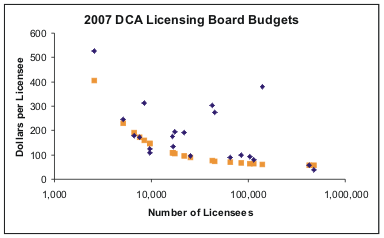
The physical therapy board, the occupational therapy board, and the registered nursing board all lie along the fitted curve. The fitted curve thus likely gives a reasonable estimate for the annual expenditures to be expected of a massage board, unless the need for onsite inspections by board staff was significantly higher for massage. While a private certification agency under legislative supervision is contemplated for California under SB 731, it is likely that it would require similar expenditures to a board. One major difference would be that it would not be subject to state hiring freezes.
The greater cost per licensee for smaller professions (<10,000) motivates why legislatures would consider placing regulation, if needed, under an existing board or administrative bureau rather than creating a new board.
23 January 2008
Massage Kiosks, Costs, and Profitability
Last Sunday's San Francisco Chronicle ran a story on the massage kiosk (Zubio) effort being floated by David Palmer and Sam Keller. The article notes the difficulties of finding space and achieving profitability in a commercial environment. Palmer has long been an advocate of bringing massage into people's work lives rather than forcing people to come to massage.
Arizona May Consolidate Health Care Boards
A story in the Arizona Republic reports that Arizona Governor Janet Napolitano is pushing to consolidate a number of health care and personal service regulatory boards under a single administrative umbrella. Napolitano is supporting a series of bills in the Legislature to eliminate nine inactive boards and consolidate more than 30 others. The result might be along the lines of the Texas Department of State Health Services (DSHS) or New York State's Office of the Professions (OP). Such consolidation rarely makes individual professions happy, but it does provide a means of regulating for the public benefit and lowers administrative costs. Having such consolidations doesn't imply that domain experts can't be consulted as needed by the regulatory agency.
Another take on Colorado's Massage Regulation
An article from Colorado Spring's KOAA TV notes that El Paso County is frustrated with the state neither licensing massage practice nor allowing the county to do so. Such input may put more pressure on DORA, which recently recommended against state licensing. This is another reminder that much of the push for state licensing has little to do with the actual practice of massage and more with oversight of commercial touch.
The article links to a nonprofit working against human trafficking started by a massage school. The nonprofit, in turn, links to a number of other NGO's involved in such work against trafficking. In some ways, however, prostitution and trafficking are not synonymous, as brought out in a recent Economist article on a conference on Selling Sex (19-25 Jan 2008 issue) and by a Canadian article on decriminalizing sex work and activism by sex workers. I've also run across a European article extensively reviewing both demand and economic forces enabling trafficking. The latter article is especially significant in discussing that for some, the economic hope and life possibilities are so poor that being trafficked looks better than staying home. It's also worth noting, that whatever the cultural myths, trafficking and prostitution both require relatively local demand. This demand is coming from within the same culture trying to suppress its visible effects — a clear indication of a significant, undealt with social schism. In any case, there is much that can be worked on at an earlier stage than law enforcement. As an example, I'll point to my Ramblemuse Touchpoints blog on Three Cups of Tea linking to Greg Mortenson's work in creating schools in remote areas of Pakistan. A little hope and opportunity could greatly reduce the supply side of trafficking. It would seemingly take a lot more early training in empathy and social connection to reduce the demand side.
The regulatory association between massage practice and sex work is one that massage practitioners consider to be about on the same level as most people consider spam — something that they would be happy to see go away and never come back. Moving regulation from the local to the state level hasn't done away with that tacit association. The structure is still about control of commercial touch rather than about defining explicit outcomes for competence. The advantage is not in structure, but in uniformity of entry requirements and in escaping the unwillingness of a relatively few local agencies to recognize that massage therapy is a well-established profession in its own right. A recent foray into Google Books turned up book references to “Swedish Massage” dating back into the late 19th century.
01 January 2008
MPS Entries for 2007 Archived
The MPS entries for 2007 have been moved into their own archive file. There's also a link to the old index page from the archive index page on the navigation bar to your left.
If you came here via a link or search to the old index entries, there may be a date hash of the form "#pyymmdda" following the "index.html" at the end of the URL in your browser's address bar. When you get to the archived file, go to that date to see the entry you were seeking. You can even copy the "#pyymmdda" hash here, and paste it on the new page, then hit the enter key to go there. Here's a JavaScript based link that does all of that for you.
It is through each of our individual efforts that together we work to keep or get our profession and practices independent of unnecessary and/or onerous regulation. It is the responsibility of the state to protect the public from harm. It is the job of the profession itself, independent of the state, to develop norms of practice for particular client populations and contexts.
Liberty means responsibility. That is why most men dread it. — George Bernard Shaw, Man and Superman, "Maxims: Liberty and Equality", 1905

