Business Survival Rates
This post was spurred by a recent discussion of the massage therapy Entry-Level Analysis Project (ELAP). The project itself concerns expanding a job task analysis into a set of competencies. However, the description of project motivations contains the statement that inconsistencies in massage education have resulted in “too many massage school graduates who experience short, unsuccessful careers”.
While spa employers of massage school graduates are becoming more prevalent, I believe that single-person practices still dominate massage careers. Thus, it’s worth asking if the survival rate of such practices is vastly different than that for small businesses in general. With that as a goal, I’ll put aside anything specific to massage for a bit and first look at small businesses in general.
Looking for business survival rates brings us to the Bureau of Labor Statistics (BLS) and the table of Survival of private sector establishments by opening year. Scott Shane (see resources) already did an article on survival rates of the 1992 cohort of businesses and another one on the mortality rates of ‘infant’ businesses using the 1994 cohort. I’m going to look at the 1994 to 1999 cohorts — the businesses for which I have at least twelve years of data from the BLS tables. My starting point is the percentage of businesses that survive at a particular age given that they’ve survived prior years (i.e. incremental survival rates). This data makes up the first seven columns of Table 1 and is displayed as a scatter plot in Figure 1.
The next column of Table 1 is a nonlinear, least-squares fit to the incremental survival rates (s1). The fit, being the solid line in Figure 1, is of the form:

where, a, b, and c are 2.65, 2.77, and 0.151, respectively. The only motivation for this particular equation is that it naturally lends itself to the shape of the data, changing rapidly when years is small and saturating when years is large.
The last two columns are the incremental loss rates (100 minus the survival rates) and the net survival rates over the span of years. These data are plotted in Figure 2.
| Age (years) |
1994 (%) |
1995 (%) |
1996 (%) |
1997 (%) |
1998 (%) |
1999 (%) |
Fit (%) |
Yearly Loss (%) |
Survival (%) |
|---|---|---|---|---|---|---|---|---|---|
| 0 | 100 | ||||||||
| 1 | 79.8 | 79.2 | 79.0 | 78.8 | 80.6 | 79.6 | 79.7 | 20.3 | 79.7 |
| 2 | 85.8 | 86.6 | 85.6 | 87.1 | 85.7 | 84.9 | 85.4 | 14.6 | 68.0 |
| 3 | 89.3 | 88.2 | 89.3 | 88.2 | 87.2 | 87.3 | 88.2 | 11.8 | 60.0 |
| 4 | 89.6 | 90.5 | 89.6 | 88.3 | 88.9 | 90.1 | 89.9 | 10.1 | 54.0 |
| 5 | 91.5 | 90.5 | 90.2 | 89.9 | 90.9 | 91.6 | 91.1 | 8.9 | 49.1 |
| 6 | 91.3 | 91.0 | 91.2 | 91.9 | 92.5 | 92.3 | 91.9 | 8.1 | 45.2 |
| 7 | 91.8 | 91.9 | 92.5 | 92.8 | 93.1 | 93.5 | 92.6 | 7.4 | 41.8 |
| 8 | 92.5 | 93.3 | 93.5 | 93.2 | 94.0 | 93.5 | 93.1 | 6.9 | 38.9 |
| 9 | 93.3 | 94.0 | 93.6 | 94.7 | 93.9 | 93.5 | 93.5 | 6.5 | 36.4 |
| 10 | 94.2 | 93.8 | 94.4 | 94.1 | 94.0 | 92.0 | 93.8 | 6.2 | 34.1 |
| 11 | 94.6 | 94.7 | 94.5 | 94.3 | 92.7 | 93.5 | 94.1 | 5.9 | 32.1 |
| 12 | 95.6 | 94.7 | 94.6 | 92.9 | 93.9 | 95.3 | 94.4 | 5.7 | 30.3 |
| 13 | 94.7 | 94.9 | 94.0 | 94.2 | 95.4 | – | 94.6 | 5.5 | 28.7 |
| 14 | 94.8 | 93.7 | 94.2 | 95.3 | – | – | 94.7 | 5.3 | 27.2 |
| 15 | 93.7 | 94.6 | 95.5 | – | – | – | 94.9 | 5.1 | 25.8 |
| 16 | 94.5 | 95.6 | – | – | – | – | 95.0 | 5.0 | 24.5 |
| 17 | 95.7 | – | – | – | – | – | 95.2 | 4.8 | 23.3 |
| 18 | – | – | – | – | – | – | 95.3 | 4.7 | 22.2 |
| 19 | – | – | – | – | – | – | 95.4 | 4.6 | 21.2 |
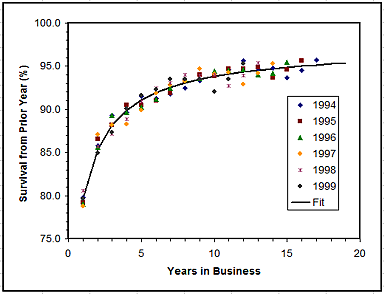
Figure 1: Percent of businesses surviving that survived the prior year
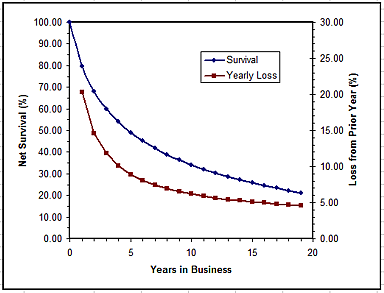
Figure 2: Percent of businesses surviving from opening (blue) and yearly closure rates of businesses that survived prior years (red)
What these data make clear is that the first years are critical ones for a business — 20% of total closures happening in the first year and 77% of the closures by year 10 occurring in the first 5 years. These are total U.S. statistics and vary between economic sectors and geographic areas. While the 5 year survival on the total private sector is 49.1%, the healthcare and social assistance businesses have a 5-year rate of 59.5%, averaged over the same set of cohorts. Retail trades has a similar average of 52.3%.
In a report analyzing business closures, Headd (2001) makes several points. About two-thirds of employer firms survive at least 2 years and about half survive at least 4 years. Half of non-employer businesses (self-employed without employees) would survive about 2 years, and about a third would survive 4 years. Non-employer survival rates are thus about 70% of employer survival rates (page 6).
Closures are not synonymous with business failures. Of the business closures, about a third are considered to be successful at closure (page 15). Successful closures could be a result of finding value in the learning experience and/or being enticed to close a business and work for an employer (page 12).
Being a relatively young owner, being in services or retail trade, not having any capital, and being in an urban/suburban area led to a higher likelihood of closure. Part of these closures likely are a result of availability of alternative job opportunities (page 9).
With all the above in place, it’s time to return to some considerations specific to massage therapy. For a 2004 report on massage therapy status and training tends in California, I had obtained survival cohort data from Associated Bodywork & Massage Professionals (ABMP) for massage school graduates as a function of initial education hours (pp. 20-21, Table 10, Figure 9 of that report). Figure 3 here displays the entry and survival data for the 500+ hour graduate cohort; 92.0%, 71.0%, 56.6%, 48.1%, 40.9%, and 34.7%, from zero to five years. The first number, 92.0%, is the percentage of graduates initially entering practice. Also shown are the net survival curve from Figure 2 and Headd’s two and four-year survival estimates for non-employer businesses.
It’s notable that the massage therapy survival data falls between the two other curves. Also, as seen in the training trends report, survival upon entering practice was not strongly dependent on training hours. Of those actually entering practice, 5 year survival was 37.7% for the 500+ hour training cohort and 34.3% for the 250-300 hour cohort; a 3.4% increase in 5-year survival for a doubling of training hours.

Figure 3: Percentage of businesses surviving over time (as in Figure 2; blue), non-employer survival, and massage graduate business survival.
The data do not reveal that massage practice survival is anomalously poor compared to businesses in general; particularly for non-employer businesses. While massage therapy is generally considered to be healthcare, the economic structuring of practice likely differs. There is, for example, far less use of joining an existing group practice as a means of entering the business side of the profession. Those creating a practice are less likely to have substantial prior experience in practice nor as likely to have working capital to “buy time” for a business to become successful.
Nor is a self-employed creator of a new business as likely to be able to provide for their health insurance as a person entering an established healthcare practice. While the Affordable Healthcare Act (ACA), may somewhat relieve this (and/or allow those up to 26 to remain under parent-provided health insurance), the structure of healthcare in the U.S. is known to create an entrepreneurial disincentive. While education, particularly realistic education in business, plays a part, business survival rates have many more facets than just education to consider, including, for massage therapy, the physical and close interpersonal aspects of the work.
Oat Hulls and Wheat Chaff. Not for everyone. Submit your resume to see if you qualify. — Garrison Keillor
Resources
Brian Headd, 2001. Business Success: Factors Leading to Surviving and
Closing Successfully, Working Papers 01-01, Center for Economic Studies,
U.S. Census Bureau.
Bureau of Labor Statistics. Business Employment Dynamics – Entrepreneurship and the U.S. Economy.
Bureau of Labor Statistics. Business Employment Dynamics – Establishment Age and Survival Data.
Bureau of Labor Statistics. Survival of private sector establishments by opening year.
Shane, Scott. Startup Failure Rates — The REAL Numbers, Small Business Trends. 28 April 2008 [based on 1992 cohort data].
Shane, Scott. Businesses Face High Rates of Infant Mortality, Small Business Trends. 14 May 2012. [Based on 1994 cohort data].


Leave a Reply